
No Products in the Cart
Winter Food Webs: The Snow Layer That Connects Everything

Snow Isn’t Empty. It’s a Roof.
A fresh snowfall can trick us into thinking everything paused.
But snow doesn’t erase life—it reorganizes it.
It acts like a blanket and a ceiling at the same time, creating a hidden world underneath and a brand-new “map” on top. Suddenly, ecosystems aren’t just horizontal (forest to field). They’re vertical.
That’s the winter secret:
The snow layer connects everything.
What moves under it feeds what hunts over it. What survives in it supports what survives beyond it. One layer becomes the meeting point for predator and prey, energy and hunger, shelter and risk.
And if you want students to truly understand winter ecology, don’t start with “hibernation.”
Start with the question winter asks every animal:
Where do you get energy when the world is cold?
The 3-Layer Winter Food Web (The “Stacked Ecosystem”)
Think of winter as a three-story building:
1) Above the Snow (The Sky & Perch Level)
This is the predator zone—where hunters search, listen, glide, and scan.
Who lives here?
- Owls (barn owls, great horned owls, snowy owls regionally)
- Hawks (some still hunt in winter)
- Coyotes and wolves moving across open areas
- Ravens and other scavengers
What matters up here?
- visibility
- wind
- perches
- and most importantly: prey availability
Owls are the best “winter food web poster child” because they link the layers beautifully: they hunt over snow… but their food is often moving below it.
2) On the Snow (The Surface Level)
This is the travel-and-risk zone. Tracks, trails, and exposed movement happen here.
Who uses it?
- Rabbits and hares bounding between cover
- Foxes and coyotes trotting along edges
- Deer traveling between bedding and browsing
- Weasels popping in and out
- Humans… which matters, because we pack trails that animals often use too
What happens here?
This is where winter shows you behavior:
- who hugs the brush line
- who crosses the open
- who took the “easy route”
- who got chased
If snow is nature’s notebook, this is the page students can read without any special equipment.
3) Under the Snow (The Subnivean Zone)
This is the hidden engine room of winter.
The subnivean zone is the space between the ground and the snowpack. It’s insulated. It’s warmer than the air above. It’s where small mammals can move, feed, and avoid the worst of winter—at least until predators find them.
Who lives here?
- voles
- mice
- shrews
- insects and overwintering invertebrates
- seeds and plant matter that becomes winter fuel
Why it matters:
This layer is the base of many winter food webs. If the subnivean zone is healthy, prey survives. If prey survives, predators can too.
So snow isn’t just weather.
Snow is habitat infrastructure.
The Big Connection: Owls Are the “Thread” Between Layers
Owls are built for winter’s stacked ecosystem.
They hunt over fields and edges, but they’re often targeting animals that:
- move in tunnels under snow
- pop up briefly on the surface
- or travel along cover lines
That’s why owl pellets are such a powerful teaching tool: they’re basically a printed receipt of the winter food web.
Pellets show:
- what prey was available
- what habitat is supporting
- what trophic links are active right now
In other words: students don’t just hear the food web.
They can literally hold the evidence.
Fun Fact
Snow depth can change the entire predator-prey balance. In deeper snow, prey may move more under the surface, and predators may shift hunting strategies—or burn more energy trying. Winter food webs are dynamic, not static.
Classroom Connection: Build the 3-Layer Winter Web (Above / On / Under)
This is a high-impact activity because it turns “food web” from a flat diagram into something students can see as a system.
Materials
- 3 sheets of paper (or one large poster divided into 3 bands)
- markers
- optional: printed animal cards
- optional: string/yarn for connections
Step 1: Create the three layers
Label:
- Above Snow
- On Snow
- Under Snow
Step 2: Add organisms to each layer
Give students a starter set like:
Under Snow: vole, mouse, shrew, seeds/grass
On Snow: rabbit, deer, fox
Above Snow: barn owl, great horned owl, hawk, coyote
Step 3: Draw energy arrows (who eats whom)
Have students connect:
- Seeds/grass → vole/mouse
- Vole/mouse → owl
- Rabbit → owl / fox
- Mouse → fox
- Deer (carcass) → scavengers (optional)
Step 4: Add “winter pressure” cards (the thinking step)
Give each group a condition and have them update the web:
- “Deep snow this week”
- “Icy crust on top”
- “No perches near the field”
- “Rodent numbers drop”
- “A packed human trail appears”
Ask:
- Which connections weaken?
- Which predators struggle?
- Which animals shift layers?
This is where students stop memorizing and start reasoning.
Extension: CER Mini-Write
Claim: Which layer is most important for the whole winter web?
Evidence: Use at least 3 connections from your diagram.
Reasoning: Explain how energy moves through the layers.
Product Spotlight: Owl Pellets + Prey Charts/Posters
If you want this lesson to stick, pair the web with a real-world data source.
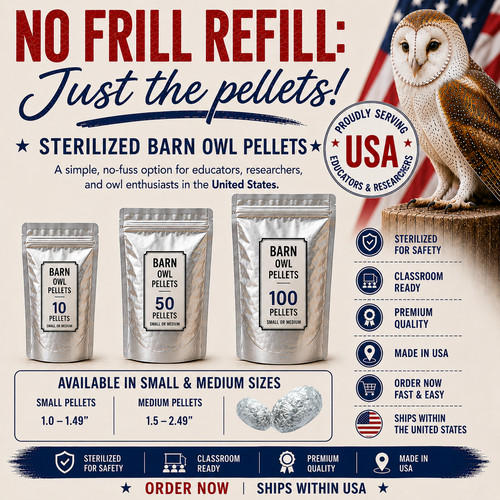
Owl Pellets (the evidence)
Owl pellets let students:
- identify skulls and bones
- count prey types
- compare pellets across groups
- infer what the local habitat supports
That turns your 3-layer web into something measurable: “What prey shows up most? What does that mean for the under-snow community?”
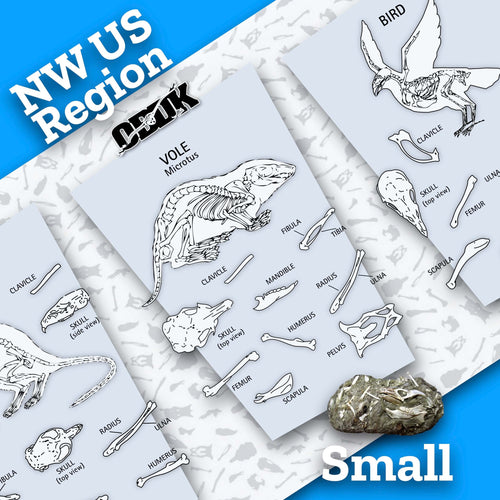
Prey charts/posters (the visual anchor)
A prey ID chart or classroom poster makes the jump from “bones” to “species” way smoother—especially for younger grades and English learners. It also helps students connect the pellet lab back to the layered web on the wall.
Teacher Takeaway
Winter ecosystems aren’t frozen in place.
They’re stacked.
And snow is the layer that connects everything:
- shelter below
- movement on top
- hunting above
Teach students that winter is a vertical food web, and you’ll watch their thinking change. They stop seeing snow as “empty season” and start seeing it as a living system—quiet, layered, and working hard.
Because in winter, the question isn’t “What lives here?”
It’s:
“What connects to what… and how do we know?”