
No Products in the Cart
Snow = Nature’s Notebook: Reading Tracks Like a Story

The Day Snow Turns Into Paper
A snowy field looks empty—until you look down.
That’s when the whole landscape starts talking.
Fresh snow is nature’s clean notebook: a reset, a blank page, a chance to see what usually stays hidden. And the best part? The “writing” isn’t random. Winter is expensive. Every step costs energy. Every minute in the open is risk. So the marks animals leave behind aren’t just footprints—they’re decisions.
But here’s the twist:
Some of the most dramatic winter stories aren’t written by feet at all.
They’re written by wings.
Owls are winter’s quiet editors—moving through the night, hunting with precision, and leaving behind the kind of clues that make students feel like real wildlife detectives. Snow doesn’t just show you who walked by. It shows you who hunted, who escaped, and who didn’t.
Tracks Aren’t Footprints. They’re Decisions.
A footprint is a mark.
A track is a choice.
In winter, animals are constantly balancing:
- food vs safety
- speed vs stealth
- warmth vs movement
- energy saved vs energy spent
That’s why a trail tells you more than “what animal.” It tells you how the animal was living that day.
And when you add owls into the mix, tracking becomes even richer—because owls connect two worlds at once:
- the subnivean zone (small mammals moving under the snow)
- the night sky (silent hunters scanning from above)
In other words: the snow is both a page and a stage.
How to Read a Track Like a Sentence (The 4-Part Story Method)
This is the framework that works with any age group and any campus trail.
1) WHO was here? (The Character)
Start with description before identification.
Look for:
- shape: hoof vs paw vs hopping dots
- size: tiny (mouse), medium (rabbit/fox), large (deer)
- toes/claws: canines often show claws; cats often don’t
- extra marks: tail drags, belly slides, wing taps
Owl note: Owls often don’t leave “walking tracks” in snow because they’re not traveling on foot. Instead, you’re hunting for owl evidence—and it’s just as exciting:
- wing impressions
- talon marks
- prey struggle prints
- pellets
- “whitewash” (the chalky droppings near roosts)
Owls don’t always write with footprints. They write with punctuation.
2) HOW was it moving? (The Verb)
Track spacing and pattern tells you the action:
- walking: steady rhythm
- trotting: more direct line
- bounding: paired prints (rabbit/squirrel)
- running: longer strides + messy snow spray
Owl note: Owl movement “verbs” are often revealed in what prey did:
- a mouse trail that suddenly explodes into scattered prints
- a rabbit line that veers sharply toward cover
- a tight swirl in the snow (panic + escape attempt)
Sometimes you don’t see the owl. You see the moment the prey realized it was there.
3) WHERE did it go? (The Setting)
Where animals move tells you what they value:
- edges (shrubs, fences, tree lines) = safety
- open field = risk, speed, urgency
- packed trails = energy-saving travel lanes
Owl note: If you want owl stories, pay attention to:
- field edges (classic hunting zones)
- fence posts and tree limbs (perches)
- open meadows near brush (prey movement + owl access)
Owls love places where prey is active and visibility is good.
4) WHAT happened? (The Plot)
This is where tracking becomes a real narrative.
Look for:
- scatter patterns = alarm or chase
- circling = searching/foraging
- drag lines = tail, wing, or something carried
- converging trails = encounter
Owl note: One of the best winter “plots” is an owl strike.
Signs can include:
- a wing print: broad, soft-edged impressions like someone pressed a feathery cape into the snow
- two small punch marks: talons hitting hard
- a burst of chaotic tracks: prey scrambling
- then… silence: because the story ended quickly
Not every owl hunt leaves a perfect imprint, but when it does, it’s unforgettable.
Owl-Focused Clues: The Winter “Footnotes” Kids Love Finding
Here are the owl-specific signs that turn a snowy walk into a full-on investigation:
1) Wing Impressions (The Snow Angel That Isn’t an Angel)
If an owl drops onto prey, its wings can brush or press the snow—especially if the snow is fluffy and fresh. The imprint may look like:
- a broad “V” shape
- a shallow sweep on both sides
- feather textures in the best-case scenario
Even a partial wing mark is gold in a classroom discussion.
2) Pellets (The Evidence Packet)
Owls swallow prey and later regurgitate a compact pellet of fur and bones. In winter, pellets stand out:
- on snow under trees
- at the base of fence lines or barns
- near roosting spots
Pellets tell you what owls are eating, which tells you what prey is available, which tells you what the habitat is supporting. That’s a whole ecosystem lesson sitting in a lump of fur.
3) Whitewash + Roosting Areas (The “Owls Live Here” Sign)
If students find chalky splatters beneath a dense evergreen or a quiet branchy area, that can hint at a roost. Combine that with pellets, and you’ve got a strong clue that owls are using the space.
4) Prey Trails That “Break the Rules”
Mouse and vole trails often look like tiny dotted lines or shallow grooves—especially where they move under the snow. If you see a trail suddenly:
- ends abruptly in open space
- explodes into scattered prints
- shows a tight swirl
…you might be reading the moment something swooped in.
Fun Fact: Owls Hunt the World Under the Snow
Small mammals like voles and mice travel in the insulated space under snow called the subnivean zone. It’s warmer down there, safer from wind, and full of tunnels.
Owls are built to exploit that hidden world:
- many species can hear prey moving beneath snow
- they can locate a target without seeing it
- and they strike with precision through a thin layer
So when your students see quiet snow and think “nothing’s happening,” the truth is the opposite:
Under that snow, it’s busy.
Above that snow, something is listening.
Classroom Connection: “Owl Hunt Mystery Map” (40–60 minutes)
Goal: Use tracking + owl evidence to teach predator/prey relationships, habitat, and scientific reasoning.
Materials
- paper or clipboards
- pencils
- optional: printed track photos (rabbit, mouse/vole, fox/coyote, deer)
- optional: measuring tape for stride/spacing
Step 1: Build a winter habitat map
Students draw:
- open field
- brush edge
- tree line
- a fence line or posts
- optional “barn” corner (great for the owl connection)
Step 2: Add prey movement first
Have students place:
- a rabbit bounding trail (cover to cover)
- a vole/mouse trail (edge-heavy, possibly “tunneled” lines)
Ask: Where would you move if you were small and edible?
Step 3: Add the owl as the unseen predator
Now introduce “owl evidence cards” (teacher reads, students add to map):
- “You find two pellets beneath an evergreen near the field edge.”
- “There’s a wing impression in the snow near scattered prey prints.”
- “Whitewash appears under a branch overlooking the meadow.”
Students decide:
- Where is the owl likely hunting from?
- Where is it roosting?
- Where is the highest prey activity?
Step 4: Write the track story (Claim–Evidence–Reasoning)
Students write:
- Claim: What happened last night?
- Evidence: Which clues support it? (tracks + owl signs)
- Reasoning: Why would an owl hunt here in winter?
Extension: Make it cross-curricular
Have students write a “Wildlife Report” headline:
“Midnight Hunt Leaves Mystery Marks Near Field Edge”
…and back it up with evidence like real investigators.
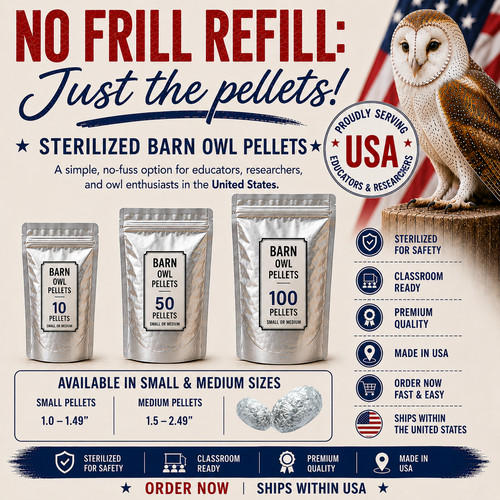
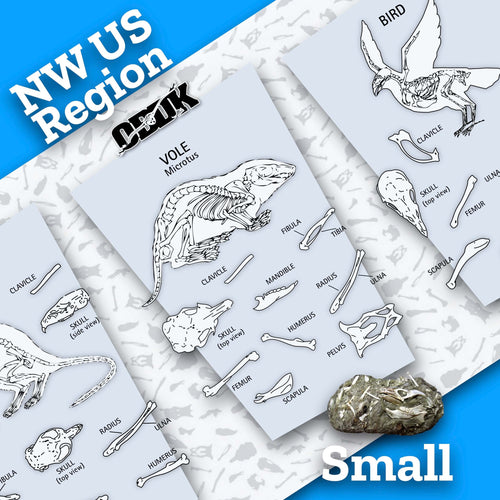
Product Spotlight: Owl Pellets (and Why They Belong in This Lesson)
Tracking is the hook. Owl pellets are the proof.
When you pair a snowy tracking story with an owl pellet lab, students get the full predator-prey arc:
- snow shows the moment
- pellets show the pattern
Pellets let kids:
- identify prey types
- compare diet across samples
- chart biodiversity
- connect “what owls eat” to habitat health
If snow is the notebook page, owl pellets are the stapled-in appendix.
(And they’re a perfect bridge when winter weather keeps you indoors.)
Teacher Takeaway
Snow is nature’s notebook—but owls are one of its best authors.
They don’t leave loud trails.
They leave evidence.
So the next time it snows, don’t just ask:
“Whose footprints are these?”
Ask the question that turns students into wildlife readers:
“What happened here… and how do we know?”
Because winter isn’t quiet.
It’s just written in a softer font.