
No Products in the Cart
Owl Snow Angels: What Wing Prints Reveal About Hunting

There’s a special kind of winter moment that stops kids mid-step.
Not a deer track. Not a rabbit hop.
A big, feathery “snow angel” pressed into fresh powder—two wide wings, a body imprint, and sometimes a scatter of tiny tracks that look like someone dropped a handful of pepper across the page.
If you see one of these out in a field or along a meadow edge, here’s the twist:
That “snow angel” might be evidence of a hunt.
What Is an “Owl Snow Angel,” Really?
When an owl strikes at prey on the snow (or just under it), it may flare its wings for balance and control—like a parachute braking at the last second. Those wings can leave a broad, symmetrical imprint that looks uncannily like a snow angel.
This is winter ecology at its best because it’s a scene you can read:
- The snow recorded the motion
- The feathers shaped the stamp
- The prey left the punctuation
And kids who think tracking is only about footprints suddenly realize:
Tracks can be wings, too.
How to Read the Story in the Snow
Next time you find one, pause and treat it like a crime scene (the fun, science kind).
1) Start with the shape
A classic owl “angel” often has:
- Two sweeping wing impressions (wide arcs on either side)
- A central body mark (where the owl’s weight pressed down)
- Sometimes a tail drag (a short line or brush mark behind the body)
Big idea: Wings down often means the owl was stabilizing, not just casually landing.
2) Look for talon marks
Zoom in near the center. You may spot:
- Small punctures or slashes in the snow
- A tight cluster of deeper marks where the owl grabbed
Big idea: Talon marks are the “contact point”—where predator meets prey.
3) Follow the “scatter”
If prey was on the surface, you might see:
- Tiny tracks that suddenly stop
- A burst of messy footmarks (panic movement)
- A drag mark leading out (sometimes prey escapes; sometimes it doesn’t)
Big idea: A sudden stop can mean a successful strike—or a near miss where prey dove under cover.
4) Check the edges: where are you?
“Owl snow angels” are most likely where hunting makes sense:
- field edges
- meadow margins
- fence lines
- brushy borders
- open areas near trees (perches!)
Big idea: The habitat tells you why the owl was there in the first place.
Which Owls Leave These Clues?
Different owls hunt differently, but the “snow angel” pattern often shows up with owls that hunt open areas or edges—especially when they’re dropping down quickly to grab small mammals.
You don’t need to name the species to teach the lesson. Instead, focus on the adaptation:
- Silent flight helps owls approach without announcing themselves.
- Powerful talons do the grabbing.
- Precision hearing helps them target tiny movements in grass or snow.
- Wide wings provide control in a last-second strike.
That’s the win: students connect structure → behavior → evidence.
Fun Fact
Owls don’t just “see prey.” Many species can hunt by sound—locking onto tiny rustles under vegetation or snow. That’s one reason snow angels often appear near places where rodents travel: grassy edges, tucked pathways, and sheltered margins.
Classroom Connection: The Track-Story Lab (Clue Cards + CER)
This is the perfect “bring the outdoors inside” lesson—especially if you can’t count on fresh snow outside your school.
What you’ll do
Students analyze “clue cards” that represent the evidence found at a winter hunting site, then write a CER explanation (Claim, Evidence, Reasoning).
Step 1: Set the scene
Tell students:
“A wildlife biologist found a ‘snow angel’ imprint in a field. What happened here?”
Step 2: Give groups clue cards
Each group gets 6–10 cards (printable or hand-written). Examples:
Core clue cards
- “Two wide wing sweep marks on either side of a center imprint”
- “Four small puncture marks near the center”
- “Tiny rodent tracks lead toward the center… then stop”
- “Tracks are near a brushy edge beside an open field”
Optional twist cards
- “Rodent tracks reappear 3 feet away and dive into thick grass” (near miss)
- “A small drag mark leads toward a fence post” (prey carried)
- “Feathers found nearby” (struggle or preening)
- “Multiple wing marks overlap” (more than one attempt)
Step 3: Students write CER
Claim: What likely happened?
Evidence: Which clues support it? (require 3 pieces)
Reasoning: Explain how the evidence connects to owl hunting behavior.
Step 4: Share + debate
Different groups will interpret the same clues in different ways—and that’s exactly what real field science feels like.
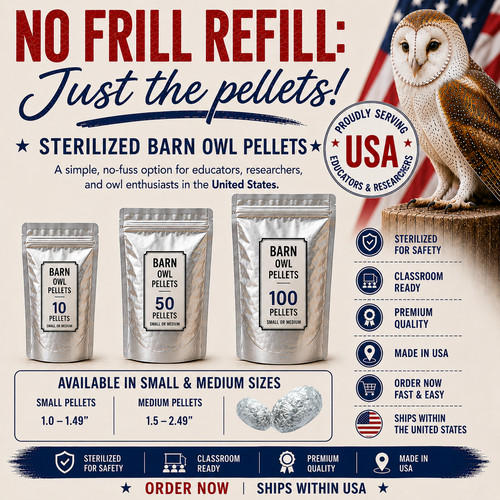
Product Pairing: Owl Pellets = “Inside Proof”
This is where your lesson becomes unforgettable.
If the snow angel is the outside story, owl pellets are the inside proof.
Use owl pellets to help students:
- identify prey types (rodents, small birds, etc.)
- connect prey remains to local habitats
- build a simple classroom food web from real evidence
Make it a two-part investigation
- Snow Angel Lab: “What happened out there?”
- Pellet Lab: “What does the owl actually eat?”
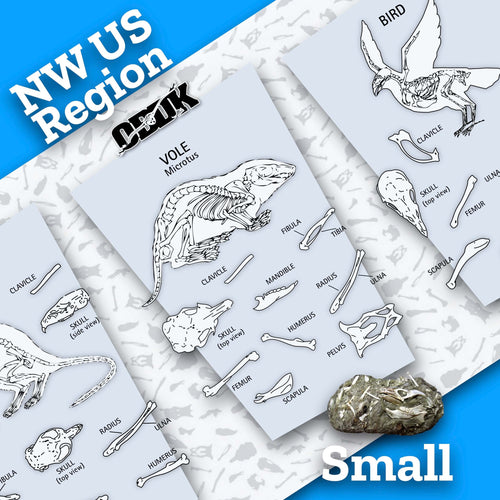
Add a prey ID chart/poster as the visual bridge so students can move from “bones” to “species” confidently.
Teacher Tip
Have students end with one final prompt:
“Write the hunt as a 6-sentence story—only using evidence.”
No guessing allowed unless it’s labeled as an inference.
It’s a sneaky, brilliant way to reinforce observation vs. interpretation.
The Takeaway
Snow doesn’t just show you who walked by.
Sometimes, it shows you what happened.
And when kids discover that an owl can leave a “snow angel” behind—a frozen snapshot of a hunt—you’ve officially turned winter into a living science notebook.