
No Products in the Cart
What Is an Owl Pellet?
An owl pellet is the compact bundle of fur, feathers, bones and other indigestible material that an owl regurgitates after a meal. It is not droppings — a pellet never passes through the owl's intestines. It forms in the stomach and comes back up through the beak, usually once or twice a day.
Why do owls produce pellets?
Owls swallow small prey whole. Their glandular stomach dissolves the soft tissue, but bones, teeth, claws, fur and feathers cannot be digested. The owl's muscular stomach (the gizzard) compresses that leftover material into a tight, felt-like mass, which the owl later expels orally. If you want the full journey, our illustrated guide How Are Owl Pellets Formed? follows one barn owl meal step by step, from beak to pellet.
What does an owl pellet look like?
A typical barn owl pellet is dark grey to brown, oval, and 1 to 2.5 inches long — roughly the size and shape of a thumb, sometimes much larger. Fresh pellets have a moist sheen; the pellets used in classrooms have been dried and heat-sterilized, so they are odorless and safe to handle.
What is inside a pellet?
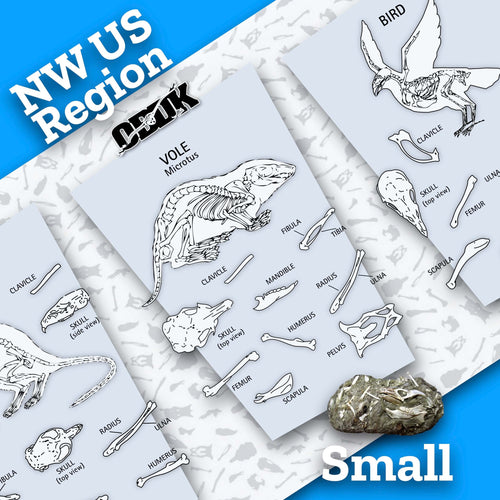
Whatever the owl ate. Barn owl pellets most often contain the skulls, jaws, limb bones and vertebrae of voles, mice, shrews and moles, all wrapped in fur. Depending on region and season you may also find bird bones, insect exoskeletons, or even crayfish parts. Because bones pass into the pellet largely intact, a single pellet is a complete record of one or more meals — which is why scientists use pellets to survey small-mammal populations without ever trapping an animal.
Which owls make pellets?
All of them — and so do hawks, eagles, herons, gulls and even crows. Barn owl pellets are the classroom standard because barn owls swallow prey whole and digest bone poorly, so their pellets contain the most complete, most identifiable skeletons. Great horned owl pellets are larger and more varied; you can compare them in our Horned Owl Pellets collection.
What can you do with one?
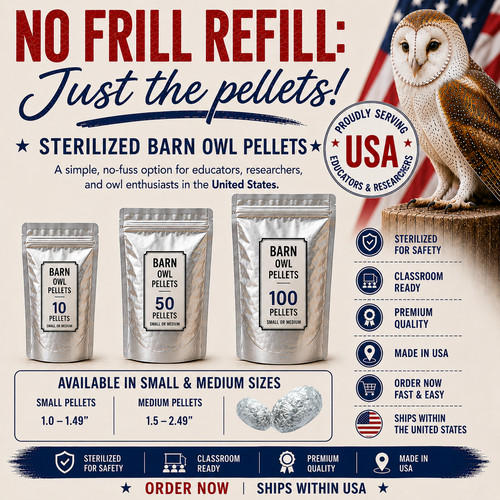
Dissect it. Teasing a pellet apart and sorting the bones is a hands-on lesson in food chains, anatomy and data collection, suitable from elementary school to university. Start with our step-by-step guide How to Dissect an Owl Pellet, keep the Owl Pellet Bone Identification Chart next to you while you sort, and when you are ready, pick up sterilized barn owl pellets for dissection in small, medium and jumbo sizes.
Quick facts
- Pellets are regurgitated, not excreted — they are pressed fur and bone, not waste.
- A barn owl typically produces 1–2 pellets per day.
- Pellet contents change with the seasons as prey populations shift.
- OBDK has supplied heat-sterilized pellets to classrooms since 1996.