
No Products in the Cart
Owl Pellet Bone Identification Chart
Once you have teased an owl pellet apart, the real detective work begins: figuring out which animal each bone came from. This guide walks through the bones you are most likely to find in a barn owl pellet and the features that tell a vole from a shrew, a mole from a mouse, and a mammal from a bird.
Start with the skull
The skull is the most diagnostic bone in the pellet, and most barn owl pellets contain at least one. Look at three things:
- Teeth. Rodents (voles, mice, rats) have a large gap between long, curved front incisors and flat grinding cheek teeth. Shrews have a continuous row of small, sharp, red-tipped teeth. Moles have pointed teeth without the red tips.
- Size and shape. Vole skulls are boxy with flat-topped molars; mouse skulls are more delicate with bumpy molars; rat skulls are noticeably larger than both.
- Eye sockets. Birds have very large eye sockets and a lightweight, thin-walled skull, often with the beak still attached.
The bones you will find, one by one
- Skull and mandibles (jaws). Lower jaws often separate into left and right halves — count them in pairs to estimate how many prey animals are in the pellet.
- Scapula (shoulder blade). Flat and fan-shaped in mammals; long and narrow in birds.
- Humerus, radius and ulna (front limb). The humerus has a rounded head; mole humeri are unmistakable — short, wide and paddle-like, built for digging.
- Pelvis. Butterfly-shaped, with round sockets where the femurs attach.
- Femur, tibia and fibula (hind limb). The femur has a ball joint; the tibia is the longest, straightest bone in most pellets.
- Vertebrae and ribs. Numerous and small; fine hair-like ribs usually belong to the smallest prey.
- Bird bones. Hollow, thin-walled and very light. A keeled breastbone is a giveaway.
How to use a bone identification chart
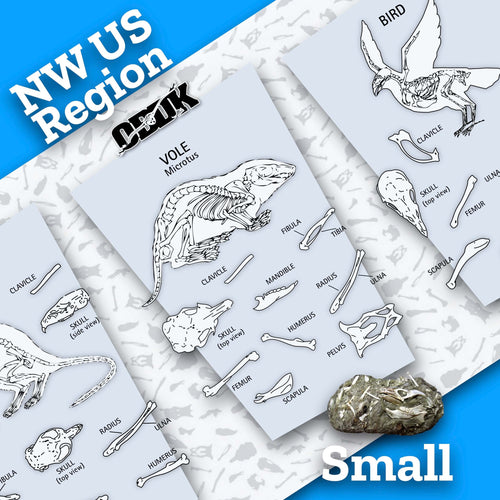
Work over a sheet of white paper. Sort bones by type first — skulls together, jaws together, limb bones together — then match each group against the chart. Gluing your finds onto a printed chart in anatomical position is a satisfying way to finish the lab and makes a great classroom display. Every OBDK pellet order ships with bone charts, and our classroom kits pair one chart per student.
Estimating what the owl ate
Count skulls and pairs of jaws to get a minimum number of prey. A single medium barn owl pellet usually holds 1–3 prey animals; jumbo pellets often hold three or more. Recording species and counts across a class set of pellets turns the dissection into a genuine population survey — the same method field biologists use.
Keep going
- New to pellets? Start with What Is an Owl Pellet?
- Haven't opened yours yet? Follow How to Dissect an Owl Pellet.
- Need pellets or extra charts? Browse barn owl pellets for dissection.