
No Products in the Cart
Pellet Seasonality: What’s on the Menu Changes With the Weather

Hook: Same owl. Different season. Different prey.
Reality check: With classroom pellets, we can’t know the exact season a pellet was cast. But we can teach seasonality the way ecologists do it: patterns + plausible explanations + evidence-based reasoning.
Barn Owls are basically night-shift field biologists who leave you a compact report. Not a written report, obviously. A fur-and-bone one.
And here’s the part that turns a pellet lab into a real ecology unit:
Barn Owl pellets reflect what was available and catchable in the landscape. When weather shifts the landscape, the “menu” shifts too—not because the owl suddenly developed a seasonal preference, but because prey access changes.
So instead of asking: “What season is this pellet from?” (we can’t know), we ask the more scientific question:
“What seasonal conditions could produce a prey pattern like this—and why?”
That’s the move. That’s the lesson.
Why Barn Owls Are the Perfect “Seasonality Owl”
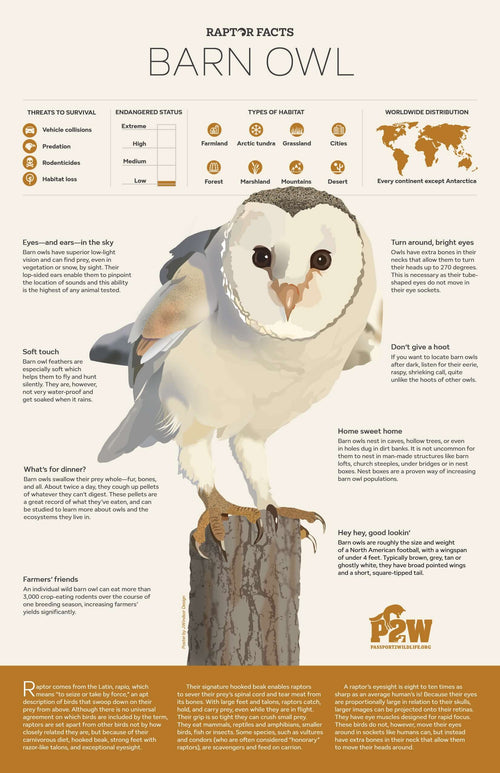
Barn Owls hunt low and quiet over open habitats—fields, grass edges, fencelines, ditches, and the messy margins where rodents live. Their diet is strongly small-mammal focused: voles, mice, shrews (and sometimes rats depending on location).
That consistency is exactly what makes them so useful for a seasonal lesson:
- If the predator stays pretty consistent…
- but the prey pattern shifts…
- something about the environment is doing the steering.
Barn Owls don’t chase trends. They chase what they can catch.
What Changes With the Weather
Seasonality isn’t just “winter is cold and spring is warm.” It’s a set of ecological switches that change prey behavior and predator access.
1) Snow cover changes the rules of access
Snow can act like a roof. Many rodents travel in the subnivean zone (the space under snow), protected from wind and many predators. The prey can still be abundant—but harder to reach.
Translation for students: Winter doesn’t remove prey. It changes how exposed it is.
2) Vegetation changes hiding places and runways
As grasses grow back, rodents gain cover and predictable “runway” travel routes. That changes where a Barn Owl’s best hunting lanes are: edges, openings, and low vegetation corridors.
Translation: Spring doesn’t “add prey.” It changes how prey moves.
3) Rodent cycles change abundance
Some small mammals, especially voles, can rise and fall in cycles. A “vole-heavy” year can create one kind of pellet pattern; a lean year can create another.
Translation: Not all seasons are equal—some years are boom years.
4) Human land use can mimic seasonal effects
Harvest, mowing, and storage areas can concentrate rodents in predictable places. For Barn Owls, that can change what’s easiest to catch.
Translation: Habitat isn’t only natural—land use changes the menu too.
What Barn Owl Pellets Tell You (Without Pretending We Know the Season)
Instead of labeling pellets by season, we treat seasonal conditions as scenarios that can shape what a predator catches.
Here are three “season scenarios” that students can use to explain pellet patterns. These are not claims about any specific OBDK pellet—they’re ecological models.
Scenario A: Deep Snow Winter (The “Snow Filter”)
What’s happening:
- Rodents may travel under snow (subnivean)
- Prey is present but less visible
- Openings, edges, and thin snow areas matter most
What a pellet pattern might suggest:
- A strong signal of the prey that remained most accessible under those conditions
- Potentially lower diversity if access is restricted (region-dependent)
Student-friendly phrase:
“Winter acts like a filter. The owl catches what the landscape allows.”
Scenario B: Fall Edge Season (Stable Access)
What’s happening:
- Minimal snow barrier
- Rodent activity is high along edges and around structures
- Hunting lanes are open and predictable
What a pellet pattern might suggest:
- Consistent small mammal signatures
- Potentially strong vole/mouse presence depending on habitat
Student-friendly phrase:
“In fall, access is stable—so the pellet looks like the field.”
Scenario C: Spring Ramp-Up (Changing Cover + Rising Demand)
What’s happening:
- Vegetation returns and cover increases week to week
- Owl families may be nesting, increasing food demand
- Prey movement shifts with growth and temperature
What a pellet pattern might suggest:
- Continued small mammal dominance
- Sometimes higher total prey evidence across a class dataset (because effort and feeding can increase during nesting)
Student-friendly phrase:
“Spring changes both the landscape and the workload.”
The Big Lesson: Pellets Are Evidence of Access, Not Just Abundance
This is the concept that makes students sound like ecologists:
A pellet doesn’t only reflect what prey exists. It reflects what prey was available, detectable, and catchable.
So when prey patterns shift, students learn to ask:
What changed in the habitat—cover, snow, movement routes, or timing?
That’s seasonality.
Classroom Connection
Activity: “Seasonality Without Labels” — Build the Dataset, Then Explain the Season
Big idea: You don’t need a pellet labeled “winter” to teach winter ecology. You need students to practice the real scientific move: compare patterns and propose explanations.
Time
1 class period (or 2 if you want strong CER writing)
Materials
- OBDK Barn Owl pellets (any pack)
- Prey ID chart/poster
- Class data table (whiteboard, poster paper, or shared doc)
- “Season Cards” (provided below)
- CER template (Claim / Evidence / Reasoning)
Step 1: Collect the data (unlabeled on purpose)
Each group dissects 1–2 pellets and records counts in simple categories:
- vole
- mouse
- shrew
- “unknown small mammal / unsure” (allowed—this is real science)
Teacher upgrade: add a confidence column (High / Medium / Low). Students learn accuracy matters more than guessing.
Now the class has multiple datasets: Dataset A, Dataset B, Dataset C… Not “winter/fall/spring.”
Step 2: Hand out Season Cards (these are scenarios, not labels)
Give each group the same three cards:
Season Card 1: Deep Snow Winter
- Rodents travel under snow (subnivean)
- Access is limited; edges/openings matter
- Hunting favors what’s easiest to detect/catch
Season Card 2: Fall Edge Season
- Little/no snow barrier
- Edges, barns, and fencelines concentrate rodents
- Prey movement is high; access is stable
Season Card 3: Spring Ramp-Up
- Vegetation returns; hiding cover increases weekly
- Nesting season can increase demand
- Prey patterns shift as habitat changes
Step 3: Match one season card to your dataset
Each group chooses the season card that best fits their dataset pattern.
But they must include a scientist sentence:
“We can’t know the true season of this pellet, but our pattern is consistent with ____ conditions because ____.”
This is the “honesty clause” that makes the activity rock-solid for teachers.
Step 4: Write the CER
Claim (choose one):
- “Our dataset is most consistent with ____ seasonal conditions.”
- “Seasonal conditions can change prey accessibility, which can change what Barn Owls catch.”
Evidence (numbers required):
- “We found ___ vole, ___ mouse, ___ shrew in our pellet(s).”
- “Our dataset shows higher/lower diversity than Dataset B.”
Reasoning (connect to a driver):
- snow cover changes access
- vegetation changes hiding/runways
- prey cycles shift abundance
- spring demand increases deliveries
CER sentence frame:
“Season affected prey because ____ changes ____ (access/cover/movement), which would lead to ____ in a Barn Owl’s diet.”
Step 5 (Optional): Peer review “challenge round”
Groups post their season match + one-sentence justification.
Another group asks: “What other season card could also explain your data?”
Original group replies with a limitation statement.
That’s scientific thinking in miniature.
Field Notes
Keep It Barn Owl-Specific (So It Doesn’t Turn Into “All Owls Ever”)
Any time discussion gets too broad, anchor with Barn Owl truths:
- Habitat: open fields + edges
- Hunting style: low flight + listening + quick drop
- Diet signature: small mammals dominate; pellets are rich in fur and small bones
Then ask the best Barn Owl question:
“If this is a Barn Owl, what does this prey mix suggest about the habitat around it?”
Now your pellet lab is habitat science.
Product Pairing That Actually Supports the Science
This lesson only works if IDs stay consistent across groups. That’s why the best pairing is practical:
- Barn Owl pellets (hands-on evidence)
- Prey ID chart/poster (consistent identification = consistent dataset)
Because seasonality discussions get wobbly when identification is wobbly.
The Takeaway
A Barn Owl pellet is not a time-stamped receipt. It’s an evidence packet.
Same owl. Different conditions. Different prey pattern.
And when students compare pellet datasets and justify seasonal scenarios with CER, they learn the real ecology lesson:
Ecosystems aren’t static diagrams. They change with weather, cover, and access—and predators record those changes in the most hands-on way possible.