
No Products in the Cart
Why Do Bats Hang Upside Down?

Hook: the weirdest bedroom in nature.
Imagine walking into your bedroom, climbing onto the ceiling, locking your feet in place, and going to sleep upside down.
Sounds uncomfortable, right? For a bat, that is just bedtime.
Bats are famous for hanging upside down in caves, tree hollows, barns, bridges, and bat houses. But they are not doing it to be spooky. They are doing it because their bodies are built for a very specific kind of life: resting safely by day and flying fast by night.
So the real question is not just, “Why do bats hang upside down?”
It is: what problem does upside-down living solve?
Roosting: Where Bats Spend the Day
Bats are nocturnal, which means many species are active at night and rest during the day. Their daytime shelter is called a roost.
A good roost is not just a sleeping spot. It is protection.
Bats may roost in:
- Caves
- Tree hollows
- Under loose bark
- Rock crevices
- Bridges
- Barns and attics
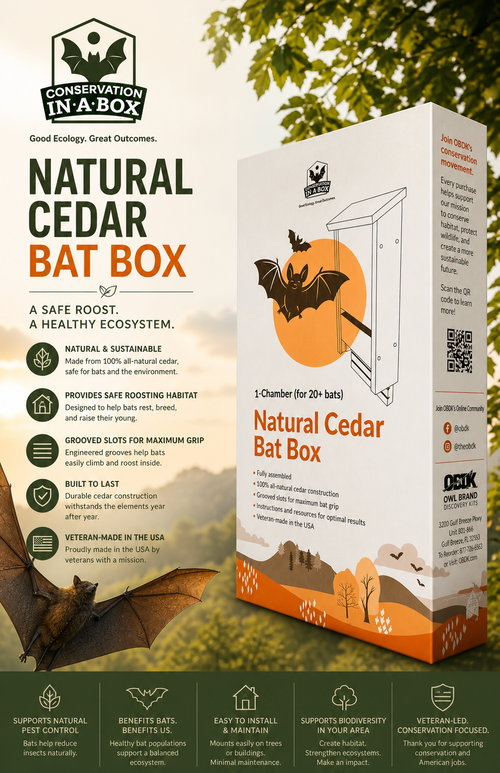
- Bat houses
The best roosts are usually dark, sheltered, and hard for predators to reach. Hanging upside down lets bats use spaces that many other animals cannot easily use.
A tiny crack in a cave ceiling? Perfect. The underside of a bridge? Works nicely. A high wooden bat house? That can be a safe daytime hideout too.
For students, this is a great reminder: habitat is not just “where an animal lives.” Habitat is where an animal solves its survival problems.
Takeoff: Why Hanging Helps Bats Fly
Here is the funny thing about bats: they are amazing flyers, but many are not great at launching from the ground.
Birds can usually push off with strong legs, flap hard, and lift into the air. Bats are different. Their wings are made of thin skin stretched across long finger bones, which gives them beautiful control in flight but does not make ground takeoff easy.
Hanging upside down gives bats a shortcut.
When a bat is ready to fly, it can simply:
- Let go
- Drop
- Open its wings
- Catch the air
- Fly away
That little drop gives the bat the space and momentum it needs to begin flying. It is like starting a bike on a hill instead of trying to pedal from a dead stop.
So upside-down roosting is not random. It is a launch system.
Tendons: The Built-In Locking Trick
Now comes the coolest part.
Bats do not have to “hold on” the way we would.
If you tried hanging from a bar all day, your hands would get tired fast. Bats have a special tendon system in their feet that helps them grip while using very little energy.
When a bat hangs upside down, its body weight pulls on the tendons in its legs and feet. That naturally curls the toes and claws into a gripping position. In other words, hanging helps lock the bat in place.
That is why bats can sleep upside down without falling. They are not clenching their feet all day like tiny athletes doing pull-ups. Their body design does the work for them.
The more they relax, the better they hang. Nature really does enjoy a clever engineering trick.
Safety: Why Upside Down Can Be Safer
A bat hanging high above the ground is harder to reach.
That matters because bats have predators too. Owls, hawks, snakes, raccoons, cats, and other animals may prey on bats when they get the chance.
By roosting upside down in high, narrow, hidden places, bats gain several safety advantages:
- They stay out of reach of many ground predators.
- They can hide in tight spaces.
- They can launch quickly if disturbed.
- They can rest in groups for warmth and safety.
- They avoid competing with many animals that cannot use ceiling spaces.
That last point is important. Hanging upside down lets bats use a part of the habitat that is almost like a secret room.
Other animals may walk on the cave floor. Bats use the ceiling.
Caves, Tree Hollows, and Hidden Homes
Not all bats live in caves. That is one of the big misconceptions.
Some bats do roost in caves, especially in large colonies. Caves can offer stable temperatures, darkness, and protection from weather.
But many bats use other shelters too:
- Tree hollows provide hidden daytime protection.
- Loose bark gives forest bats a narrow place to tuck themselves away.
- Rock cracks shelter bats in cliffs and deserts.
- Bridges and buildings can mimic natural crevices.
- Bat houses can provide alternative roosting space where natural shelter is limited.
This is why old trees matter so much. A dead or hollow tree may look messy to people, but to wildlife it can be a whole apartment building.
For bats, a safe roost can mean the difference between surviving the day and being exposed.
Classroom Connection: Design the Perfect Bat Roost
Here is a hands-on classroom activity that turns bat roosting into an engineering challenge.
Ask students to design the perfect bat roost. They can sketch it, build a simple model, or create a labeled poster.
Their roost must solve four bat problems:
| Bat Problem | Roost Design Solution |
|---|---|
| Predators might reach me | Place the roost high off the ground |
| I need to take off quickly | Include an open drop zone below |
| I need darkness and shelter | Add a narrow, shaded interior |
| I need to stay warm and dry | Use weather protection and safe materials |
Students should label features like:
- Entrance slit
- Hanging surface
- Rough gripping texture
- Predator protection
- Rain cover
- Ventilation
- Drop zone for takeoff
- Safe height
Then have them explain their design with one sentence:
“Our bat roost is safe because…”
Example:
“Our bat roost is safe because it is high, narrow, dark, dry, and gives bats space to drop into flight.”
This activity connects biology, engineering, habitat design, and animal behavior in one lesson.
Teacher Takeaway
Bats hang upside down because it solves several survival problems at once.
It helps them:
- Rest safely
- Launch into flight
- Save energy while gripping
- Avoid many predators
- Use hidden spaces like caves, hollows, and crevices
What looks strange to us makes perfect sense to a bat.
That is the beauty of animal adaptations. The weirdest behavior often turns out to be the smartest solution.
So the next time students ask why bats sleep upside down, the answer is not just, “Because they can.”
The better answer is: because upside down is exactly where a bat is built to be.