
No Products in the Cart
Sound Is a Habitat: Why Quiet Matters More in Winter

The Winter Secret Nobody Teaches: Quiet Is a Survival Tool
Winter looks still.
But it isn’t empty.
It’s just running on a different sense.
When leaves are gone and snow flattens the landscape, animals don’t get many second chances. Food is harder to find. Energy is expensive. Nights are long. And for a hunter like a Barn Owl, winter becomes a test of one thing:
Can you hear well enough to eat?
Because to an owl, sound isn’t background. Sound is information. It’s the difference between a meal and a miss. Between thriving and burning calories all night for nothing.
The Night’s Perfect Listener
Owls are often described as “seeing in the dark,” but the real story is stranger — and cooler:
Many owls hunt by sound first.
A vole rustles beneath dry grass.
A mouse scratches a seed husk.
A heartbeat shifts under cover.
In an owl’s world, those tiny noises become a map.
And winter makes that map even more important, because prey can disappear under snow or dead vegetation. That’s why owls evolved into something close to the ultimate acoustic predator: a bird built to turn faint sound into precise action.
How Owls “See” with Sound
1) The Facial Disk: Nature’s Satellite Dish
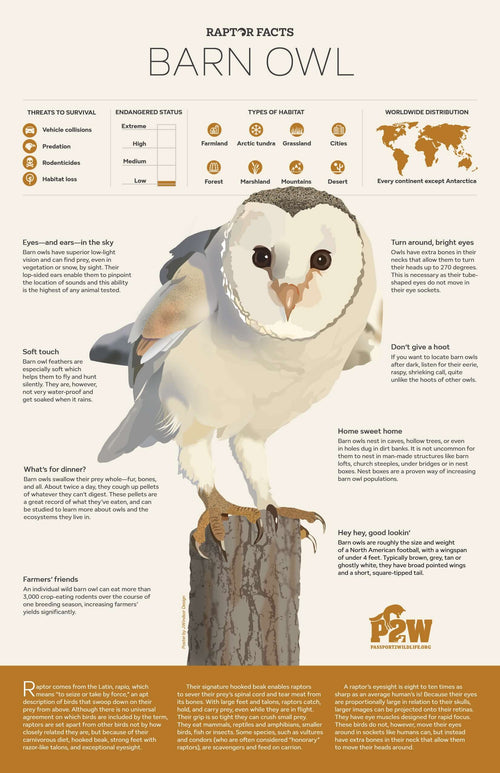
That round “face” isn’t just cute — it’s functional. The facial disk funnels sound toward the ears, helping owls detect where a noise is coming from.
2) Asymmetrical Ears: Hearing in 3D
Many owls have ear openings that aren’t perfectly level — one is slightly higher than the other. That tiny mismatch helps them measure sound timing and intensity, giving them pinpoint accuracy on prey location, even when prey is hidden.
3) Silent Flight: The Sneak Attack You Can’t Hear Coming
Owls don’t just listen well — they also stay quiet. Specialized feather edges break up turbulence so their wings move through air with less sound. The result: a predator that can hear better because it isn’t masking its own hearing.
Why Winter Makes Quiet Even More Important
Winter turns sound into a bigger deal for two reasons:
- Cover is reduced. With fewer leaves and thicker cold air patterns, noises can travel differently across open spaces. The soundscape changes.
- Mistakes cost more. If hunting success drops, an owl may need to fly farther and hunt longer — which burns precious calories on the coldest nights.
So when winter is already asking owls to do more with less… noise pollution becomes an invisible wall.
The Sound of Trouble: When Human Noise Becomes “Blindness”
To us, the hum of a road, a pump, or a distant engine can feel like harmless background.
To an owl, it can be acoustic masking — covering up the exact frequencies and tiny rustles it relies on to detect prey.
Research on wild owls and noise shows measurable hunting impacts:
- Traffic noise can reduce foraging efficiency in wild owls by interfering with prey detection.
- In a dose-response study, increased noise was linked to reduced hunting success and prey detection behaviors.
And here’s the classroom-friendly translation:
When you add noise to a sound-based hunter’s world, you don’t just annoy it — you remove information.
That’s why the phrase matters:
Silence is a habitat.
When we protect quiet, we protect life.
Fun Fact
Barn Owls can detect extremely tiny differences in sound timing — on the order of fractions of a millisecond (often shared as about 0.0003 seconds). That’s how fine-tuned their “sound map” can be.
Classroom Connection: “Sound vs. Sight” Experiment
Turn your classroom into a mini sound lab — and let students feel what noise pollution does.
What you need
- A blindfold
- A chair, bookshelf, or tri-fold board as a “divider”
- Optional: a fan, soft music, or gentle white noise (to simulate background noise)
Setup (Round 1: Quiet Room)
- Choose one student to be the “owl” (blindfolded, stationary).
- Choose one student to be the “mouse” (moves behind the divider).
- The “mouse” makes a tiny sound every few seconds (soft finger rub, a pencil tap, a quiet crinkle).
- The “owl” points to where they think the sound came from.
Track results:
- How many correct directions out of 10 tries?
Setup (Round 2: Add Background Noise)
Repeat the same steps, but add a constant background sound (fan or low music).
Ask:
- Did accuracy drop?
- Did the “owl” hesitate more?
- Did the “owl” need louder prey sounds to succeed?
The reflection question (the real lesson)
“If the only way you find food is by listening… what happens when the world gets louder?”
Teacher Takeaway
Winter teaches a truth we usually miss:
Not all habitats are made of trees and water and soil.
Some habitats are made of quiet.
When students understand the acoustic world of an owl, they start noticing the invisible parts of nature — the parts you can’t point to, only listen for.
And once they get that, they don’t just learn wildlife science.
They learn stewardship.