
No Products in the Cart
Decoding Owl Eye Color: What Yellow, Orange, and Dark Eyes Can Tell Us

Hook: the eyes give clues.
An owl’s eyes are hard to ignore. Some glow bright yellow, like little lanterns. Some burn orange, like sunset caught in feathers. Others are deep dark brown or almost black, built for the quiet hours when the world is nearly lightless.
But owl eye color is not just for looks. In many owl species, eye color can give us a clue about when that owl is most active. Not a perfect rule. Not a magic code. But a useful wildlife pattern students can learn to read.
Yellow eyes often point to daytime hunting. Orange eyes often suggest dawn and dusk activity. Dark brown or black eyes often belong to night hunters. That means owl eyes are not just beautiful. They are field clues.
Why Eye Color Matters
When students look at an owl photo, they often notice the eyes first. That makes eye color a great doorway into animal behavior.
Eye color can help students ask better questions:
- When does this owl hunt?
- What kind of light does it use?
- What prey might be active at that time?
- What other adaptations help it survive?
This is the heart of wildlife learning: one visible feature opens the door to a whole survival story.
But here is the important part: eye color should be treated as a clue, not a guarantee. Animals do not always follow our neat classroom categories. Some owls hunt outside their usual hours, and habitat, season, weather, prey availability, and human disturbance can all shift behavior.
Still, as a teaching pattern, owl eye color is wonderfully useful.
Yellow Eyes: The Daylight Clue
Owls with yellow eyes are often more active during the day.
A great example is the burrowing owl, a small ground-dwelling owl often seen standing outside its burrow in open grasslands, deserts, or agricultural areas. Its bright yellow eyes match its more daylight-friendly lifestyle.
Yellow-eyed owls may hunt or stay active when there is plenty of light. Their prey may include insects, small mammals, reptiles, or birds, depending on the species and habitat.
For students, yellow eyes can become the “sunlight clue.”
Yellow eyes often suggest:
- More daytime activity
- Open habitats
- Strong visual hunting in brighter light
- Prey that may be active during the day
- Less dependence on total darkness
That does not mean every yellow-eyed owl is only awake at noon. It means the eye color gives students a starting hypothesis.
Student-friendly shortcut: Yellow eyes? Think day hunter.
Orange Eyes: The Dawn and Dusk Clue
Owls with orange eyes are often linked with crepuscular activity. That is the science word for animals most active at dawn and dusk.
The great horned owl is a strong example students may know. Its large orange-yellow eyes fit a predator that often becomes active around twilight and hunts into the night. The Eurasian eagle-owl, with its striking orange eyes, is another dramatic example.
Dawn and dusk are special hunting windows. Light is low, shadows are long, and many prey animals are moving between daytime and nighttime routines. For a predator, that transition time can be full of opportunity.
Orange eyes often suggest:
- Dawn and dusk hunting
- Twilight activity
- Strong low-light vision
- Prey moving during transition hours
- A balance between daytime and nighttime hunting
For students, orange eyes can become the “sunset clue.”
Student-friendly shortcut: Orange eyes? Think twilight hunter.
Dark Brown or Black Eyes: The Night Clue
Owls with dark brown or nearly black eyes are often associated with deeper nighttime activity.
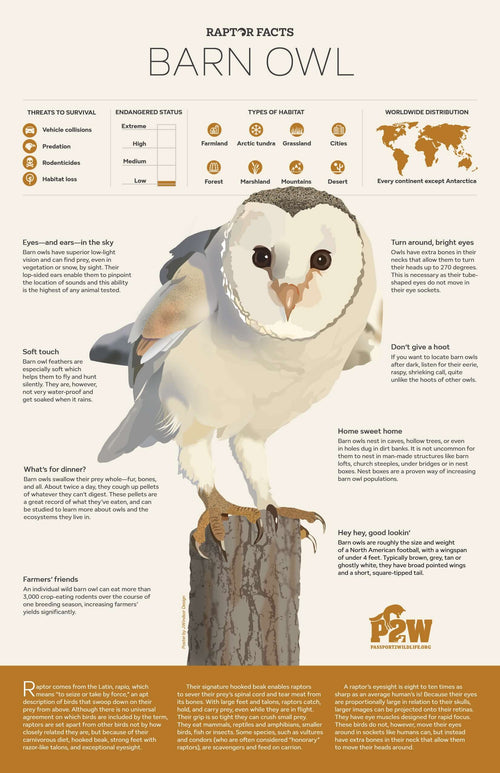
The barn owl is a perfect example. Its dark eyes sit in a pale, heart-shaped facial disc, giving it one of the most recognizable faces in the owl world. Barn owls are famous night hunters, using both low-light vision and incredible hearing to locate prey in darkness.
Dark-eyed owls are often adapted for dim conditions where color and bright light matter less than shadow, movement, and sound. At night, hearing may become just as important as sight — sometimes even more important.
Dark eyes often suggest:
- Night hunting
- Strong reliance on hearing
- Activity in very low light
- Stealth and silent flight
- Prey such as mice, voles, and other nocturnal animals
For students, dark eyes can become the “midnight clue.”
Student-friendly shortcut: Dark eyes? Think night hunter.
The Pattern Is Useful — But Not Perfect
This is where the lesson becomes more scientific.
Students love simple rules. Yellow means day. Orange means dusk. Dark means night. Easy.
But wildlife is rarely that tidy.
Eye color gives a clue, not a final answer. Some owls are flexible. A hungry owl may hunt outside its usual schedule. A nesting owl may hunt more often to feed young. Weather can change prey movement. Human disturbance can push animals into different activity patterns.
So instead of teaching eye color as a strict rule, teach it as a field hypothesis.
A student might say:
“This owl has orange eyes, so I predict it may be most active around dawn or dusk. Now I need more evidence.”
That is exactly how young naturalists should think.
More Than Eye Color: Other Clues to Hunting Time
Eye color is just one clue. Students can combine it with other evidence to make a stronger prediction.
Ask them to look for:
- Habitat: open grassland, forest, barn, desert, wetland
- Body shape: long legs, broad wings, compact body
- Facial disc: large facial disc may suggest strong hearing focus
- Prey type: insects, rodents, birds, reptiles, fish
- Behavior: perching, hovering, ground hunting, forest ambush
- Time observed: day, dusk, night
This helps students move from “one clue” to “evidence-based thinking.”
An owl with dark eyes, a large facial disc, silent flight, and a diet full of mice? That points strongly toward night hunting.
An owl with yellow eyes, long legs, open habitat, and ground burrows? That points toward more daytime activity.
The goal is not just to memorize eye colors.
The goal is to build a wildlife detective mindset.
Classroom Connection: Owl Eye Color “Time Lab”
Turn the classroom into a mini wildlife investigation lab. Instead of simply sorting owl photos by eye color, students become field biologists trying to predict when each owl hunts.
Set up three “time zones” around the room:
- Day Shift
- Twilight Shift
- Night Shift
Give each group an owl card with an image and a few clues. Do not tell students the owl’s hunting time right away.
Each card should include:
- Eye color: yellow, orange, or dark brown/black
- Habitat clue: open grassland, forest edge, barn, desert, woodland, wetland
- Prey clue: insects, rodents, birds, reptiles, fish
- Behavior clue: perches silently, hunts near burrows, glides over fields, waits at forest edges
Students must place their owl in one of the three time zones and defend their decision with evidence.
Example Owl Cards
| Owl Clue Card | Student Prediction | Evidence |
|---|---|---|
| Yellow eyes, open grassland, often seen near burrows, eats insects and small mammals | Day Shift | Yellow eyes + open habitat + visible activity |
| Orange eyes, forest edge, large predator, active when shadows are long | Twilight Shift | Orange eyes + dawn/dusk hunting window |
| Dark eyes, barn or open field, hunts rodents using sound | Night Shift | Dark eyes + strong hearing + nocturnal prey |
After each group presents, reveal the general pattern:
- Yellow eyes often suggest daytime activity
- Orange eyes often suggest dawn/dusk activity
- Dark brown or black eyes often suggest night hunting
Then add the scientist twist: students must revise their answers if needed and mark their confidence level.
Use a simple confidence scale:
- High confidence: eye color, habitat, prey, and behavior all match.
- Medium confidence: most clues match, but one clue is unclear.
- Low confidence: eye color gives a clue, but more evidence is needed.
Final Question
Ask students:
“Was eye color enough evidence, or did you need habitat, prey, and behavior too?”
That is the real lesson. Owl eye color is a clue, not a rule. Good wildlife thinking means noticing one clue, making a prediction, and then looking for more evidence.
Product Spotlight: OBDK Owl Posters and Wildlife Learning Tools
Owl eye color makes a great visual lesson because students can see the pattern right away. OBDK owl posters and wildlife learning tools help bring that comparison into the classroom, giving students real images to observe, sort, question, and discuss.
Pair this lesson with owl pellets, predator-prey charts, nocturnal animal units, or habitat studies. Students can connect eye color to hunting time, hunting time to prey activity, and prey activity to food webs.
That is where a simple question — “Why are this owl’s eyes yellow?” — becomes a full ecosystem conversation.
Teacher Takeaway
Owl eye color can help students decode when an owl is likely to hunt.
Yellow eyes often suggest daytime activity.
Orange eyes often point to dawn and dusk hunting.
Dark brown or black eyes often indicate night hunting.
But the real lesson is not just the color code. The real lesson is how scientists think: notice a clue, make a prediction, then look for more evidence.
So the next time students see an owl staring back from a poster, photo, or field guide, ask them:
What are those eyes telling us — and what else do we need to know?