
No Products in the Cart
When Owls Move On: Heat, Hunger, and the Search for Better Habitat

Hook: an owl does not pack a suitcase, but it does read the landscape.
A dry field, a silent barn, fewer mice in the grass, and a roost that bakes in afternoon heat can all send the same message: this place may not be worth the energy anymore.
Owls are often described as loyal to territories, and many species are. But loyalty has limits when food, shelter, and safety start to disappear.
So when does an owl move away? Usually not because of one dramatic moment. More often, it is a stack of clues—less prey, more heat, fewer safe resting places, and a harder night shift.
Summer Turns the Habitat Map
Summer looks abundant to us. Leaves are full, insects are busy, and daylight seems endless.
For owls, summer can be both helpful and difficult. Young birds are leaving nests, adults may still be feeding fledglings, and heat changes when prey moves.
Fields dry out: small mammals may shift into cooler cover.
Grass gets mowed: hunting cover and prey shelter can change overnight.
Old barns heat up: roosts may become stressful during the day.
Water sources shrink: prey animals may cluster in different places.
Human activity increases: summer projects, travel, and noise can disturb nesting or roosting areas.
None of these automatically means an owl will leave. Each one is a clue, not a rule.
The Resource Checklist Owls Are Reading
Owls do not “decide” the way people do, but their behavior responds to real conditions. If a place stops meeting basic needs, movement becomes more likely.
For students, this is a useful way to define habitat. Habitat is not just a pretty place on a poster; it is a working system.
Food: mice, voles, insects, small birds, or other prey depending on the owl species.
Safe roosts: shaded trees, cavities, barns, cliffs, or sheltered structures.
Nesting space: cavities, ledges, burrows, or nest boxes for species that use them.
Low disturbance: enough quiet for resting, nesting, and hunting.
Energy balance: the owl must gain more from hunting than it spends searching.
When several pieces weaken at once, an owl may expand its range, shift hunting areas, or leave a site entirely.
Heat Changes the Night Shift
Owls are built for efficient hunting, but heat still matters. Hot days can make daytime roosting harder, especially in enclosed spaces with poor airflow.
Heat can also change prey behavior. Small mammals may move less in exposed areas, feed at different times, or stay tucked under dense vegetation where they are harder to catch.
Less prey activity: fewer rustles, fewer chances.
Shorter hunting windows: owls may wait for cooler hours.
More energy spent: longer searches cost calories.
Hot roosts: poor shelter can make a site less useful.
The important teaching point is simple: heat does not just affect the owl. It affects the whole food web the owl depends on.
Food Shortage Is Often the Biggest Signal
If prey drops, owls notice quickly through hunting success. A territory that once produced several good catches may start producing long, empty flights.
This is especially important for nesting adults. Hungry chicks mean adults must hunt more often, travel farther, or switch prey when possible.
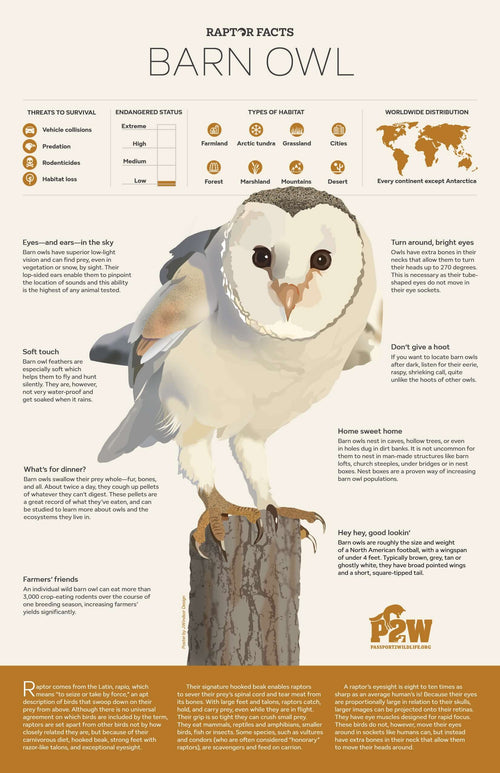
A barn owl may hunt wider field edges if rodents become scarce near the nest.
A great horned owl may shift between woods, fields, and neighborhood edges as prey availability changes.
A burrowing owl may respond to changes in insects, small mammals, vegetation height, and burrow safety.
Owls are flexible, but not unlimited. If the energy math fails for too long, moving becomes the better strategy.
Young Owls Are Built to Move
Some “moving away” is not a crisis at all. It is growing up.
After fledging, young owls often disperse from their natal area. They need to find hunting space, avoid competing with parents or siblings, and eventually locate suitable territory of their own.
Fledging: young owls leave the nest but may still depend on adults.
Exploring: they practice hunting and learn the landscape.
Dispersal: they move away to reduce competition and find resources.
Settlement: they stay where food, shelter, and safety line up.
That means movement can be a sign of stress, but it can also be a normal life stage. Students should always ask: what evidence do we have?
Signs a Habitat May Be Losing Its Owls
Teachers can help students think like field observers by focusing on patterns, not single sightings. One quiet night does not prove an owl left.
Better questions sound like this: what changed, how often, and what else changed at the same time?
Fewer pellets: possibly less roost use or reduced hunting nearby.
Less calling: may reflect season, behavior, or fewer owls present.
Abandoned nest site: could mean disturbance, failed nesting, or seasonal movement.
Habitat change: mowing, construction, tree removal, or barn repairs may alter shelter and prey.
Prey clues: fewer tracks, burrows, runways, or insect activity can matter too.
The safest science sentence is still the strongest one: “This pattern suggests a possible change, but we need more evidence.”
Classroom Connection: “Would This Owl Stay?” Resource Map
Give students a simple map of a farm, park, forest edge, or schoolyard. Add summer resource cards and let them decide whether an owl would likely stay, shift, or leave.
Materials
One habitat map per group
Resource cards: prey, roosts, nest sites, shade, water, disturbance
Change cards: heat wave, mowing, construction, drought, rodent boom, new nest box
Colored pencils for evidence marking
Steps
Mark resources: students circle food, shelter, and nesting areas.
Add summer changes: each group draws two change cards.
Make a prediction: stay, shift hunting area, or move away.
Defend with evidence: students must name at least three clues.
Rate confidence: high, medium, or low based on how many clues agree.
End with the question: Which resource mattered most, and what evidence convinced you?
Teacher Takeaway
Owls move when the habitat stops solving enough survival problems. In summer, that can mean heat stress, prey shifts, disturbed roosts, or young owls dispersing into new territory.
The lesson is not “owls leave when it gets hot.” That is too simple.
The better lesson is: owls respond to resource patterns. When students learn to track those patterns, they stop seeing movement as random and start seeing it as evidence.
Ask them: If you were an owl, what would make this place worth staying?