
No Products in the Cart
Storytime Sleuths #3: Campfire Stories of the Bat Box

Hook: Every campfire has a bat story.
Someone points at the dark edge of the trees and whispers, “I heard if you put up a bat box, hundreds of bats show up overnight.” Another student says, “My cousin says bats always fly into your hair.” Then someone spots a tiny shape flicker across the sky: silent, fast, gone. Perfect.
Because bat boxes are not just wildlife homes. They are story starters. And for your students, every story can become a science mystery: What is true? What is a clue? What needs more evidence?
The Bat Box at the Edge of the Firelight
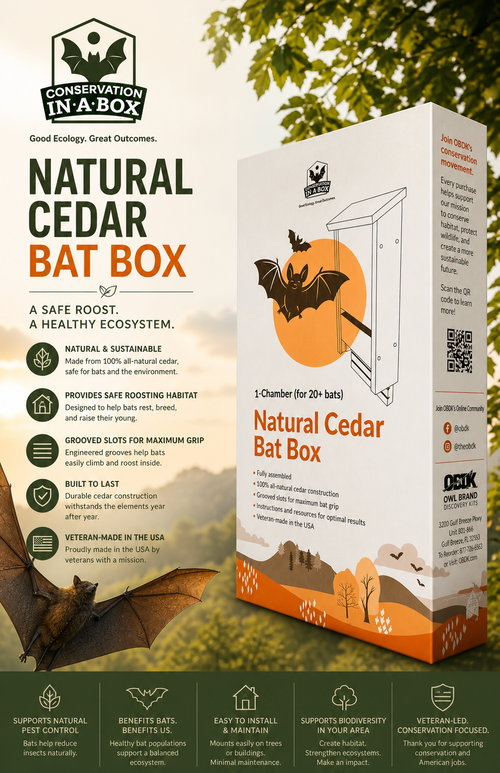
A bat box looks simple from the outside: a narrow wooden shelter mounted high on a pole, tree, barn, or building. But to a bat, it may solve a very real problem. Many bats need safe daytime roosts where they can rest, stay warm, avoid predators, and raise young. Natural roosts can include:
Tree hollows
Loose bark
Rock crevices
Caves
Bridges
Old buildings
When those natural spaces are limited, a well-placed bat box can offer an alternative. Not a magic magnet. Not a guaranteed bat hotel. A possible roost, if the conditions are right.
Campfire Claim #1: “A Bat Box Brings Bats Overnight”
This is the classic story. You hang the box, go to sleep, and wake up to a tiny bat neighborhood. Sometimes bats do find a new box quickly. Often, they do not. It can take weeks, months, or longer for bats to discover and use a bat box. Students can think of it like a “For Rent” sign in wildlife language.
The box must be visible enough for bats to find.
The temperature must work for the species and season.
The height and location matter for safety and takeoff.
The surrounding habitat matters because bats need nearby food and water.
So the story is not completely false. It is just incomplete. Bat boxes can support bats, but patience is part of the experiment.
Campfire Claim #2: “Bats Want to Get in Your Hair”
This one refuses to disappear. But bats are not aiming for your head. They are usually hunting tiny flying insects, navigating with sharp senses, and avoiding obstacles—including people.
At dusk, bats may swoop low because insects are moving low. That can feel dramatic near a campfire, especially when shadows make everything look closer than it is. Here is the better student translation:
Bat swoop: probably insect hunting.
Near people: often insects gathering around lights, warmth, or open areas.
Feeling spooky: a human reaction, not bat intention.
This is a great place to teach the difference between animal behavior and human interpretation. The bat is not “scaring” anyone. The bat is working the night shift.
Campfire Claim #3: “One Bat Box Will Eat All the Mosquitoes”
Bats do eat insects, and many are important nighttime insect predators. But “all the mosquitoes” is the kind of campfire exaggeration students should learn to notice. Different bat species eat different insects. Some may eat mosquitoes, moths, beetles, flies, or other small insects, depending on what is available. A bat box can be part of a healthier habitat, but it is not a mosquito vacuum.
Ask students:
What insects live nearby?
Is there water close enough for bats to drink?
Are there native plants supporting insect life?
Is the area too bright at night?
Are pesticides reducing the food supply?
That turns a simple claim into an ecosystem question. And that is where the real learning begins.
What Makes a Bat Box Feel Like Home?
A good bat box does not just need wood and a roof. It needs design features that match bat behavior.
Narrow chambers: bats like tight spaces that mimic crevices.
Rough interior surfaces: claws need texture for gripping.
Safe height: higher placement helps with protection and takeoff.
Warmth: many roosting bats need stable, suitable temperatures.
Clear drop zone: bats often need space below to launch into flight.
Nearby habitat: insects, water, and shelter all matter.
Placement is a clue, not a rule. What works in one region may not work perfectly in another. That is why bat boxes make such good science tools. They invite students to observe, predict, wait, and revise.
How to Read a Bat Box Like a Sleuth
Once a bat box is installed, the investigation begins quietly. Students should never open or disturb an occupied box. Instead, they can watch from a distance at dusk and look for evidence.
Safe observation clues include:
Emergence: bats leaving the box around dusk.
Guano below: small droppings may suggest use.
Flight patterns: repeated activity near the box.
Seasonal timing: activity may change through the year.
No activity yet: still data, not failure.
That last one matters. No bats today does not mean the box is “bad.” It may mean more time is needed, conditions are not right yet, or bats are using better roosts nearby. Absence is a clue, not a conclusion.
Classroom Connection: “Campfire Claim Cards”
Turn bat box stories into an evidence-sorting activity.
Materials
Index cards or slips of paper
A board labeled True, Exaggerated, and Needs More Evidence
Optional bat box photo or model
Student science notebooks
Set-Up
Write one campfire claim on each card:
“Bat boxes fill up overnight.”
“Bats always fly into hair.”
“Bats eat insects at night.”
“A bat box works best when habitat is nearby.”
“If no bats come the first week, the box failed.”
“Bright lights can affect nighttime animals.”
What Students Do
Read the claim like a mystery clue.
Sort it into true, exaggerated, or needs more evidence.
Add evidence from the lesson.
Revise one claim into a more scientific sentence.
Example revision: “A bat box may attract bats if it offers safe roosting conditions and is placed near suitable habitat.” That is a much better campfire story.
Teacher Takeaway
Bat box stories are perfect for young scientists because they sit right between mystery and evidence. A bat box might become a roost. It might take time. It might teach students just as much before bats arrive as after. The goal is not to make every campfire story disappear. The goal is to help students ask better questions.
What did we notice? What do we predict? What evidence should we look for next?