
No Products in the Cart
Spring on the Sea Ice: What Happens to Polar Bears When the Arctic “Wakes Up”

Hook: If you picture spring as green grass and puddles, polar bear spring will reset your brain.
For polar bears, spring isn’t about flowers. It’s about light returning, ice changing texture, and a short window when the Arctic becomes a hunting buffet—before the floor literally breaks apart.
Spring is when polar bears do their most important work of the year:
They eat. A lot.
Because what they gain in spring can carry them through months when the ocean turns from a frozen hunting platform into open water.
What “Spring” Looks Like Where Polar Bears Live
Spring in polar bear country is less “April showers” and more “the sun remembers how to show up.”
Here’s what changes:
1) The light comes back, fast
Days stretch quickly in the Arctic. Twilight lingers. The landscape brightens without ever truly warming the way we expect. It’s still winter-cold, but the calendar of light is shifting.
2) The snow surface firms up (and then starts to soften)
Wind-sculpted snow can become crusty. In some places, the surface gets easier to travel over—until melt cycles begin to soften it again. Polar bears move differently on hard-packed snow than on slushy spring snow.
3) Sea ice becomes dynamic
This is the big one. Sea ice in spring isn’t a fixed sheet. It’s a moving puzzle:
- pressure ridges shift
- cracks open and refreeze
- leads (open-water lanes) appear
- edges form between ice and water
To a polar bear, those cracks and edges aren’t just scenery—they’re hunting zones.
The Spring Job: Hunt Seals While the Ice Still Holds
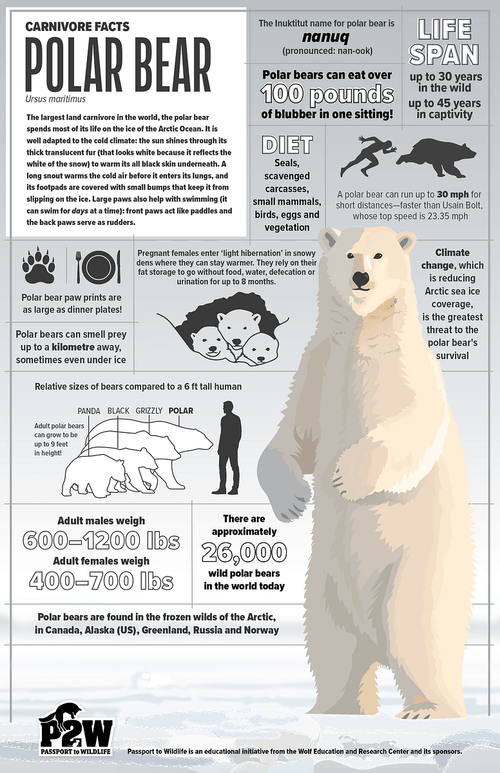
Polar bears are sea-ice hunters. Their main prey is seals, and spring is often the peak moment because seals are busy too.
Why spring is “seal season”
In many Arctic regions, spring is when seals:
- use the ice surface more
- maintain breathing holes
- rest near openings
- have pups (depending on seal species and local timing)
For a polar bear, the best hunting isn’t “random roaming.” It’s strategy:
- patrol the ice edge
- wait at breathing holes
- hunt along leads and cracks
- investigate snow-covered areas where seals may be using subnivean spaces
Spring is when the Arctic offers something rare: predictable places where prey must surface.
Moms and Cubs: Spring Can Mean “First Steps”
Not all polar bears are in the same phase in spring.
Denning moms
Females den over winter and give birth in the den. By spring, many mothers emerge with cubs that are:
- tiny compared to mom
- learning to walk in snow and wind
- completely dependent
That first post-den period is huge. Mom has to:
- protect cubs
- travel across challenging terrain
- and eventually reach good hunting areas so she can refuel
Spring is when cub survival starts getting tested—by weather, distance, and timing.
Then Comes the Hard Turn: Breakup
Spring contains a countdown.
Because as spring progresses, many regions hit ice breakup, when sea ice thins, fractures, and retreats. That changes everything.
What breakup means for polar bears
When the ice breaks up:
- the hunting platform shrinks
- seals become harder to reach
- bears may be forced toward land or remnant ice
- many bears shift into a longer period of fasting or low-food living
Polar bears can go a long time without food, but they’re not “fine” without it. Spring hunting success matters because it’s the time they can build fat reserves.
A polar bear in spring is like a student cramming before the test—except the test is surviving the melt season.
What Polar Bears Eat in Spring (And What They Don’t)
Polar bears will take opportunities when they can, but spring is primarily about seals.
They can eat:
- scavenged carcasses
- occasional birds/eggs later
- whatever is available in specific regions
But the key idea for teaching is simple:
The sea ice is the cafeteria.
When the cafeteria closes, options change fast.
A Teacher-Friendly Lens: Spring as a Habitat Shift
This is a great classroom concept because it’s not “polar bears like cold.” It’s:
Polar bears need a platform.
Spring is when that platform:
- becomes more productive (more hunting edges)
- then becomes less stable (breakup)
- then disappears in many areas (open water season)
Spring is habitat change in real time.
Classroom Connection
Activity: “Spring Ice Map” — Where Would a Polar Bear Hunt?
Goal: Students learn that habitat isn’t just “Arctic.” It’s specific features: edges, cracks, and breathing holes.
Materials:
- A simple map you draw (sea ice with an ice edge, a crack/lead, and a few breathing holes)
- Polar bear tokens + seal tokens
- Optional: “weather cards” (warm week / windy week / refreeze week)
Steps:
- Place seals at breathing holes and near the ice edge.
- Students place polar bears where hunting would be most efficient.
- They must justify with evidence:
- “Seals must surface here”
- “Edges concentrate movement”
- “Cracks create access points”
- Add a “breakup” change: remove half the ice and ask students to re-place bears and explain what changes.
CER prompt:
“Spring affects polar bears because ____ changes the ice habitat, which changes ____.”
The Takeaway
Spring for polar bears is not gentle.
It’s bright, windy, shifting, and intensely strategic. It’s the season where hunting can be excellent, right before the platform starts to vanish.
So if you want a one-line truth for students:
Spring is when polar bears race the melt.